
Project Case Study — Lake Dunlap, Southbank Community
A 1990s wood-post bulkhead and aging boathouse replaced with a complete steel-and-concrete waterfront — 120 feet of CLOC bulkhead, a double boathouse for a wake boat and pontoon, an upper-level patio, a limestone retaining wall, and a poured concrete patio at grade.
Lake Dunlap — Southbank Community
2024
Approximately 10 weeks
Marine barge for water-side pile driving on the outer boathouse pilings
The property owners in the Southbank community on Lake Dunlap reached out to Waterfront Unlimited for a complete waterfront makeover. The existing waterfront — a wood-post bulkhead and double boathouse both built in the 1990s — was at the end of its functional life. The bulkhead was failing, the boathouse was aged and in disrepair, and the homeowners wanted to replace the entire waterfront with structures designed to last for decades, not be rebuilt again in another fifteen years.
The scope was a full waterfront rebuild: install a new CLOC vinyl sheet pile bulkhead in front of the failing wood-post bulkhead, demolish and replace the aging double boathouse, build a new double boathouse for the homeowners’ wake boat and pontoon, add an upper-level concrete patio, install a limestone quarry block retaining wall to stabilize the grade, and pour a large concrete patio at grade for outdoor living between the home and the water.
Southbank properties have limited street-side access for heavy equipment, which shaped how this rebuild was executed. Land-side access alone could not reach the outermost boathouse pilings — the ones farthest from shore — for pile driving. Waterfront Unlimited used the marine barge to position the excavator on the water side of the structure, which allowed the pile-driving hammer to drive the outer steel pipe pilings to refusal where land-based equipment could not reach. This is one of the practical reasons we operate a barge: it is the only way to drive the deepest, most stable foundation on properties where the structure extends beyond what land-side equipment can access.
Removed the aging 1990s double boathouse. Demolition material was hauled off-site, with all recyclable materials separated and recycled rather than landfilled.
New CLOC vinyl sheet pile bulkhead installed in front of the existing failing wood-post bulkhead rather than removing it. CLOC panels driven by excavator-mounted hammer to consistent depth across the full 120-foot run, with galvanized steel rods tied back to deadmen anchors set 10 to 12 feet behind the wall.
Steel pipe pilings driven to refusal in the lake bed, steel framing, poured concrete deck. Two slips configured for the homeowners’ wake boat and pontoon, each with an integrated cradle lift sized to the specific watercraft.
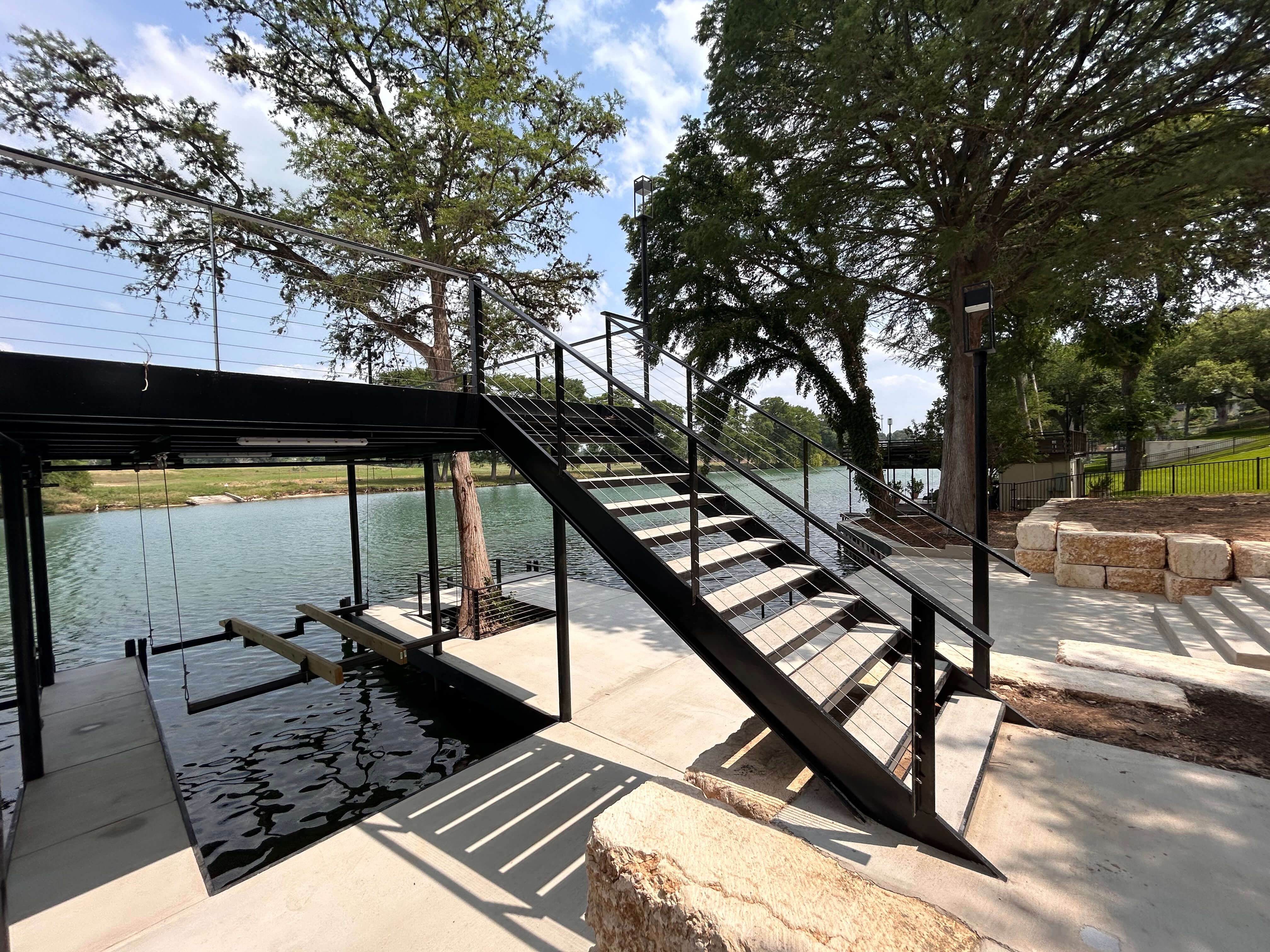
34 ft by 29 ft poured concrete deck above the boathouse, built on the same steel frame as the boathouse below. Steel staircase with cable rail connecting upper deck to the patio at grade.
Stacked limestone block wall to stabilize the grade between the home and the waterline. Sized and set to handle lateral soil pressure and integrate visually with the Hill Country setting.
Large poured concrete patio between the home and the boathouse, creating a continuous outdoor living surface from the house to the water.
Mature cypress on the shoreline preserved through demolition and construction — the boathouse and patio were laid out around it.
Every Waterfront Unlimited boathouse and dock starts with steel pipe pilings driven to refusal — the point at which the piling will not advance further into the lake bed. On this Southbank property, that approach created the foundation for the double boathouse and the upper-level patio above it. Steel framing and poured concrete decks were specified for durability — these are the materials that perform through the flood events the Guadalupe River lakes see, and they are the reason the homeowners will not be rebuilding this waterfront in 2040.
The CLOC bulkhead was driven by excavator-mounted hammer rather than by hand, which delivers consistent panel depth across the 120-foot run. Tieback rods were galvanized steel anchored to deadmen 10 to 12 feet behind the wall — the configuration that holds the bulkhead in place against lateral soil and water pressure over time.
The new bulkhead was installed in front of the existing wood-post bulkhead by design, not by oversight. Removing a failing bulkhead before the replacement is in place leaves the shoreline unprotected for the duration of construction — a real risk on Central Texas lakes, where a single significant rain event during a 10-week project window can move a meaningful amount of soil. Driving the new CLOC wall in front of the old one kept the shoreline protected from day one and let the old wall serve as a secondary line of defense behind the new system once construction was complete.
The limestone quarry block retaining wall was set on the upland side to handle the grade transition between the home elevation and the waterline. Limestone block is the right material for this setting — it carries the structural load, weathers naturally with the surrounding Hill Country terrain, and integrates with the concrete patio it edges into.
The Southbank property now has a fully integrated waterfront — bulkhead, double boathouse, upper-level patio, limestone retaining wall, and grade-level concrete patio — built as a single coordinated project rather than a series of disconnected upgrades. The wake boat and pontoon each have a dedicated covered slip with cradle lifts. The upper deck delivers a 34 by 29 ft entertaining space above the water with cable rail and a steel staircase down to the patio at grade. The limestone wall and concrete patio give the homeowners usable outdoor living from the house to the waterline with a clean, finished transition between elevations.
The homeowners have offered to serve as a reference for prospective Waterfront Unlimited clients. References are available on request.
Whether replacing an existing structure or building new, Waterfront Unlimited welcomes the conversation.
Request a Property Evaluation